French Toast Recipe: How to Make It Golden, Custardy, and Macro-Friendly
Master the French toast recipe: the best bread, the right custard ratio, pro cooking tips, common mistakes, and an easy high-protein, macro-friendly version.
Quick answer
Quick Answer: How Do You Make French Toast? Whisk one large egg with about three tablespoons of milk for each thick slice of bread, plus vanilla, cinnamon, and a pinch of salt. Soak day-old bread until it feels saturated but still holds its shape. Cook it in butter with a splash of oil over medium heat for 3 to 4 minutes per side, until deep golden and the center reaches 160°F.
The Best Ingredients for French Toast
Bread: Day-Old Beats Fresh
Think of bread like a sponge. A dry sponge drinks liquid evenly, while a damp one gets waterlogged and falls apart. Fresh, soft bread soaks up custard too fast and collapses into mush, while day-old bread has enough structure to absorb the custard and still hold together in the pan. Thick slices, roughly three-quarters of an inch to an inch, give you the best balance of crisp crust and creamy middle.
Brioche and challah are the classic picks for richness, sourdough adds tang and chew, and thick-cut Texas toast is the easy everyday option. Only have fresh bread? Lay the slices on a sheet pan in a low oven for a few minutes until they feel dry to the touch but haven't browned. If you're building a leaner version, whole-grain or high-protein sandwich breads work well too; they're usually thinner, so they need a shorter soak.
Eggs and Dairy: The Ratio Is Everything
The custard is just eggs and dairy, but the balance between them decides your texture. Too much milk and the bread turns soggy and struggles to set. Too little and you end up with a thin omelet wrapped around toast. A reliable starting point is one large egg to about three tablespoons of milk. Whole milk makes a richer custard; if you go heavier with half-and-half or cream, use less of it. Extra yolks push it richer, while extra egg whites push it leaner.
Flavor: Salt, Spice, and a Little Sugar
Salt is the most overlooked ingredient in sweet breakfasts. A pinch makes everything taste brighter. Vanilla and cinnamon are the classic pairing, and a little nutmeg or orange zest adds depth. A spoonful of sugar (brown sugar for a deeper, caramel note) does more than sweeten. That golden crust comes from the Maillard reaction, where proteins from the eggs and milk react with sugars under heat, so a little sugar in the custard helps the outside brown.
Fat: Butter, With Backup
Butter gives French toast its signature flavor, but the milk solids in butter burn quickly at frying temperature. Adding a small splash of neutral oil alongside the butter buys you more time before it scorches, so you get the buttery taste without the bitter, blackened edges.
The Classic French Toast Recipe
Serves: 2 (4 thick slices) Prep: 5 minutes Cook: 10 to 15 minutes
Ingredients
- 4 thick slices day-old brioche, challah, sourdough, or Texas toast (¾ to 1 inch thick)
- 4 large eggs
- ¾ cup whole milk
- 1 tablespoon brown sugar
- 1 teaspoon vanilla extract
- ½ teaspoon ground cinnamon
- A pinch of nutmeg and a pinch of salt
- 1 tablespoon butter plus 1 teaspoon neutral oil per batch
Instructions
- Whisk the eggs, milk, sugar, vanilla, cinnamon, nutmeg, and salt in a wide, shallow dish until completely smooth, with no streaks of egg white left.
- Heat a heavy skillet or griddle over medium heat. Set a wire rack on a sheet pan in a 200°F oven to hold finished slices.
- Lay the bread in the custard. Thinner or softer slices need about 30 seconds to a minute per side; thick, stale slices can take 2 to 5 minutes per side. The bread is ready when it feels heavy and saturated but still holds its shape when you lift it.
- Let the excess custard drip off, then cook the slices in the butter and oil for 3 to 4 minutes per side, until deep golden brown.
- Check that the center reaches 160°F. If the outside is done before the middle feels set, finish the slices on the rack in a 350°F oven for a few minutes.
- Wipe the pan and add fresh butter and oil between batches, then serve right away.
Cooking Tips That Make the Difference
Medium heat is the sweet spot. Too hot and the crust burns before the custard in the center has time to set. Too low and the bread steams instead of crisping. You want a steady sizzle the moment the bread hits the pan, not a violent one.
Soak by feel, not by the clock. Bread thickness, dryness, and type all change how fast it absorbs custard. A shallow dish lets each slice lie flat and soak evenly, and a gentle press with your fingers tells you more than any timer.
Give it room and a rack. Crowding the pan traps steam and kills browning. Once the slices are done, keep them on a wire rack instead of stacking them on a plate, where they steam each other limp.
Use a thermometer for thick slices. Food safety agencies recommend cooking egg dishes to 160°F, and egg safety guidance names French toast specifically. Thick brioche can look perfect outside while the center is still runny, so a quick check is worth it.
Common French Toast Mistakes (and How to Fix Them)
Using fresh, thin bread. It soaks up custard in seconds and tears or turns to mush. Use day-old, thick slices, or dry fresh bread in a low oven first.
Drowning the custard in milk. More milk doesn't mean more custardy. It means soggy. Keep the ratio around one egg to three tablespoons of milk.
Rushing the soak, or overdoing it. A quick dip gives you an eggy outside and a dry center. A long soak on soft bread gives you a slice that falls apart. Match the soak to the bread.
Cranking the heat. High heat creates the classic fail: burnt outside, raw middle. Stay at medium and be patient.
Frying in butter alone. The milk solids scorch, especially by the second batch. Add a little oil, and wipe the pan between batches.
Under-whisking the custard. Streaks of egg white cook into rubbery, pale patches. Whisk until the mixture is one uniform color.
French Toast Nutrition: What's Actually on Your Plate
Classic French toast isn't a nutritional villain, but it's easy to lose track of. According to USDA data, French toast made from a standard recipe with 2% milk comes in at about 229 calories, 7.7 grams of protein, 10.8 grams of fat, and 25 grams of carbohydrates per 100 grams. A typical 65-gram slice works out to roughly 150 calories and 5 grams of protein before anything goes on top.
The toppings are where the numbers jump. A quarter cup of maple syrup adds roughly 200 calories, nearly all of it sugar, and a pat of butter on top stacks more fat on a dish that was already cooked in it. Three thick slices of brioche with the works can easily outweigh a full lunch.
The upside is the eggs. A large egg carries about 6 grams of complete protein, with roughly 3.6 grams in the white and 2.7 grams in the yolk. That's the lever you pull to make French toast work harder for your goals.
How to Make French Toast More Macro-Friendly
You don't need to give up French toast to stay on track. You just need to rebalance it so protein leads and the sugar stops running the show.
Shift the custard toward protein. Replacing some whole eggs with liquid egg whites raises protein while trimming fat. Ultra-filtered milk adds more protein than regular milk, and a half scoop of vanilla protein powder whisked into the custard bumps it further. Protein powder thickens the mixture, so add a splash more liquid and whisk until there are no clumps.
Choose your bread on purpose. Whole-grain bread adds fiber, high-protein breads add a few extra grams, and slice thickness matters just as much as the brand. Read the label and count your slices.
Cook lean, finish with flavor. A light coat of nonstick spray plus a teaspoon of butter gets you browning and buttery flavor without frying the bread in fat.
Top smarter. Plain Greek yogurt, fresh berries, sliced banana, and a heavy hand of cinnamon bring texture and sweetness. If you want syrup, measure it, or use a sugar-free version.
High-Protein French Toast (Serves 2)
- 4 slices whole-grain or high-protein bread, slightly dried
- 2 large eggs plus ½ cup liquid egg whites
- ⅓ cup ultra-filtered milk or unsweetened almond milk
- ½ scoop (about 15 g) vanilla protein powder, optional
- 1 teaspoon vanilla, ½ teaspoon cinnamon, and a pinch of salt
- Nonstick spray plus 1 teaspoon butter
- To serve: plain Greek yogurt and fresh berries
Whisk everything except the bread until smooth, soak each slice 20 to 40 seconds per side, and cook over medium heat for 2 to 3 minutes per side until golden and set. With egg whites, protein powder, and ultra-filtered milk, the custard alone carries roughly 35 to 40 grams of protein for the batch, about 18 to 20 grams per serving, before you count the bread. Add your bread's label numbers for the full picture.
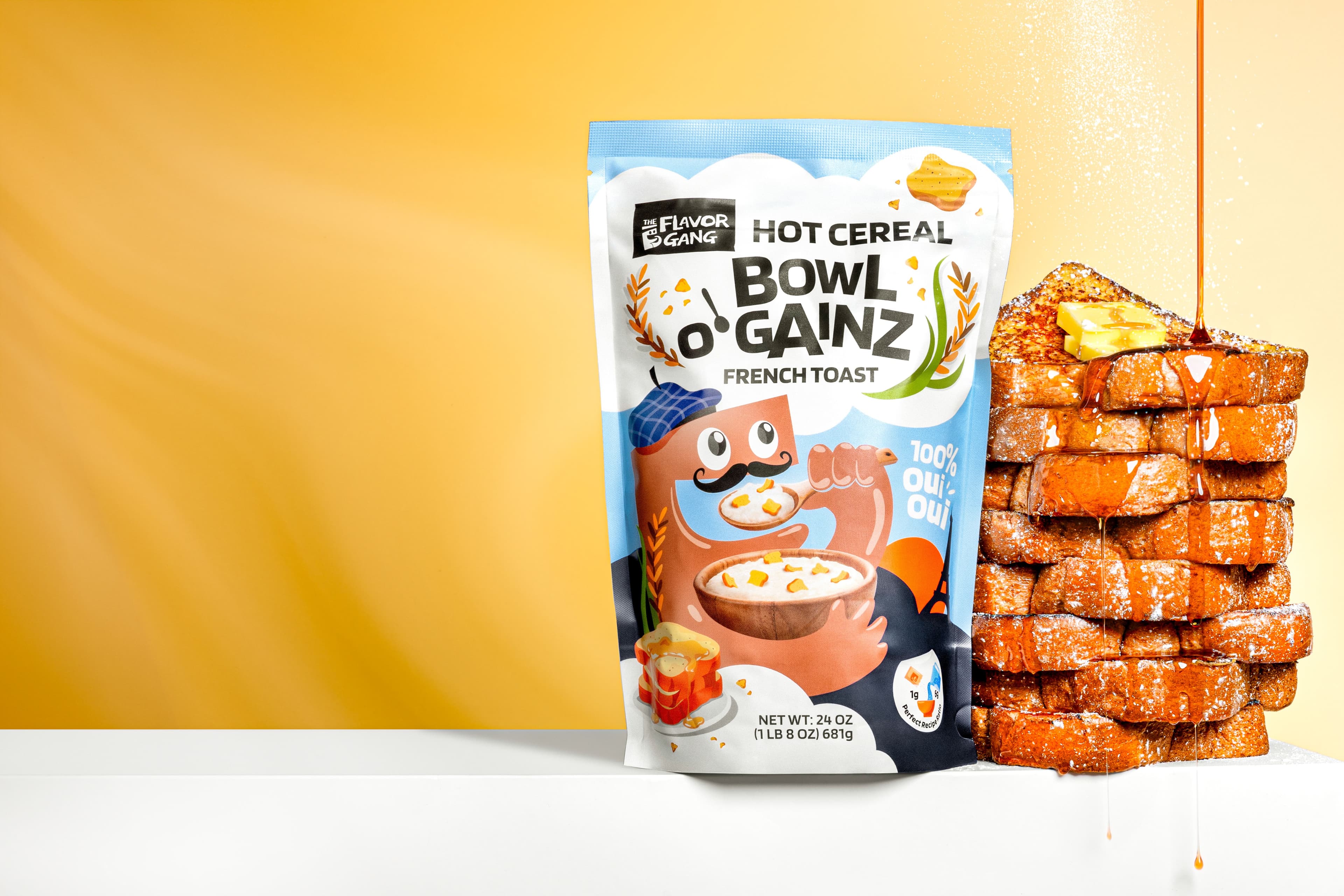
French Toast Flavor, in a Bowl: Meet French Toast Bowl O' Gainz
Here's the real talk about French toast: some mornings you want the full pan-and-spatula experience, and some mornings you have nine minutes before you leave for the gym. That's exactly why we make Bowl O' Gainz, our flavored cream of rice for people who track their carbs and refuse to eat boring.
French Toast Bowl O' Gainz takes that cream of rice base and gives it a rich, sweet, buttery, French toast–style flavor. It dropped in late August 2026 as a special edition with our retail partner Ares Nutrition, so availability can move fast. Like the rest of the Bowl O' Gainz lineup, it's built to be an easy carb source at breakfast; check the nutrition panel on your bag for exact macros.
One quick note on how we use it. Bowl O' Gainz is a hot cereal, so we make it the way the bag directs. We're not going to pretend it's a stand-in for custard or a coating for your bread. The fun is in what you build around it. Here are a few of our favorite ways to bring it to the breakfast table.
The French Toast Plate, Split Two Ways. Cook one slice of the high-protein French toast above and pair it with a small bowl of French Toast Bowl O' Gainz. The toast and eggs carry your protein, the bowl brings the carbs, and the whole plate stays on one flavor theme. It's a lot easier to hit your numbers this way than with three slices of brioche and a syrup flood.
The Toppings Bowl. Prepare a serving and top it exactly like you'd top a stack of French toast: a scoop of Greek yogurt, a handful of berries or sliced banana, a dusting of cinnamon, and a light drizzle of syrup. All of the brunch vibes, a fraction of the dishes.
The Protein-Boosted Bowl. Stir a scoop of vanilla protein powder in after cooking, adjusting the liquid until it hits the texture you like, or keep it simple with eggs or egg whites on the side. Either way, you turn a carb-forward bowl into a balanced breakfast.
The Meal-Prep Move. Portion dry servings into containers at the start of the week so breakfast is just scoop, cook, and top. Consistency beats perfection, and a breakfast you actually look forward to is one you'll actually stick with.
If the French Toast drop is gone by the time you read this, every one of these ideas works with any Bowl O' Gainz flavor.

Written by Yana Capa-Pasco
Marketing Director